Why Does Cancer Strike Some People and Not Others?
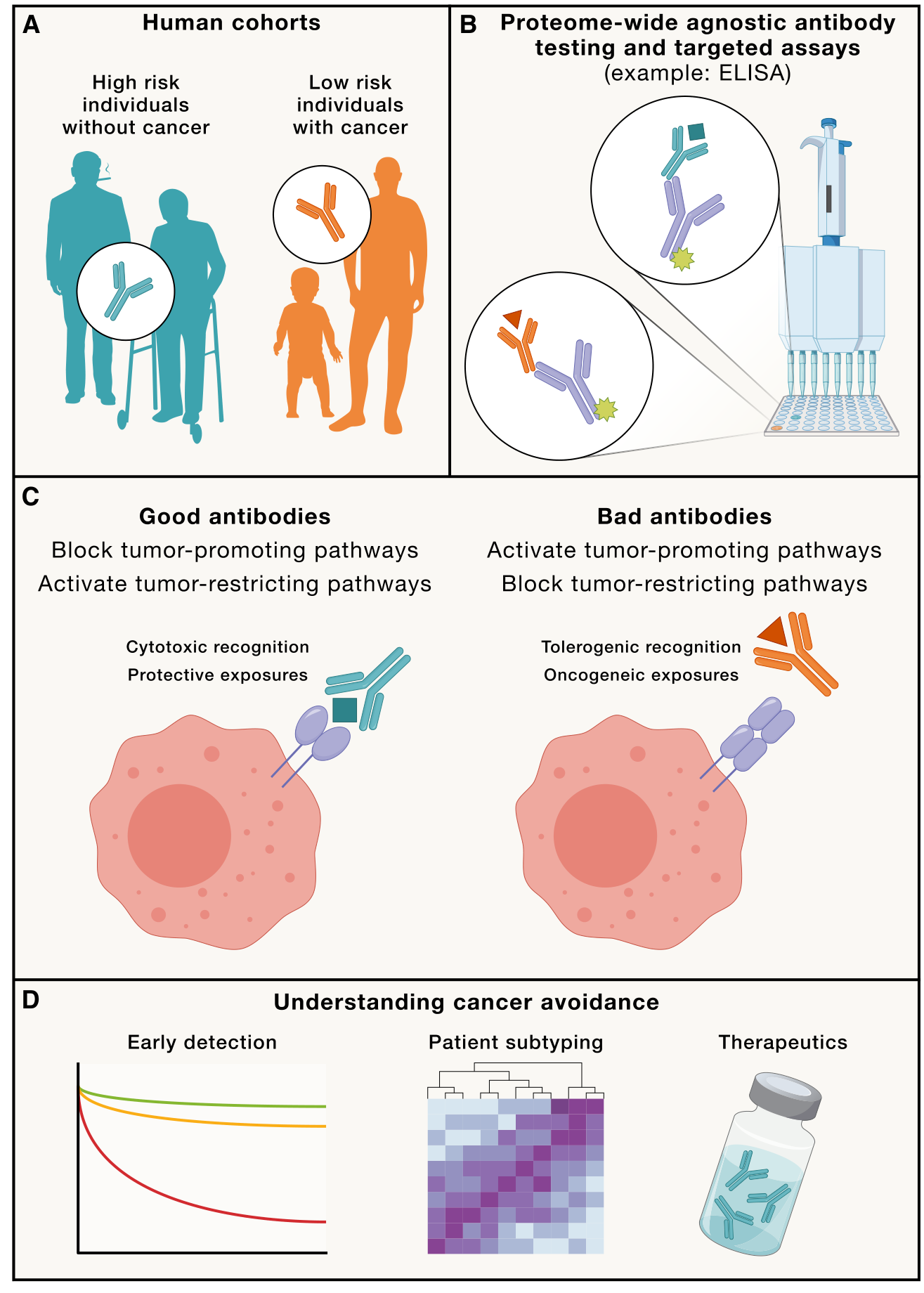
Cancer is notoriously hard to predict, even within the same person — when it will strike, and how.
Two people with the same environmental exposures and similar risk factors can end up with completely different outcomes: one goes their whole life without cancer, while the other develops it and watches it progress quickly. Even among patients with the same cancer, treatment response and prognosis vary enormously.
Age, lifestyle, genetics, and the tumor’s own characteristics explain part of this. But not all of it.
So here’s a question worth asking:
Could a person’s immune system already have been in a different state, long before the cancer ever appeared?
A 2026 Commentary in Cell, by Paul Bastard and an international collaborative team, starts from exactly this question.
“Do autoantibodies shape cancer immunosurveillance?”
The immune system is watching for cancer
Our immune system doesn’t just clear viruses and bacteria — it also hunts down and eliminates abnormally transformed cells. This is called cancer immunosurveillance.
Tumors arise more easily when the immune system isn’t working properly, and conversely, treatments like immune checkpoint inhibitors can suppress cancer — both facts point to how central the immune system is to whether cancer develops and how it progresses.
But there’s a major open question here.
Why does one person’s immune system surveil cancer effectively, while another’s doesn’t?
Bastard and colleagues propose that part of the answer may lie in antibodies.
Antibodies aren’t just a record of past defense
Our bodies carry a diverse set of antibodies that reflect what we’ve encountered in the past. Get infected by a virus, and antibodies against that virus appear. Get vaccinated, and antibodies against that specific antigen form. In that sense, the antibody repertoire is a kind of immunological record.
But antibodies don’t just record past immune responses — some of them can actually change the function of the protein they target. In particular, autoantibodies, which attack proteins that make up our own body, can directly block or alter specific immune functions.
This is already well established in infectious disease. For example, the chain
anti-type I IFN autoantibody → blocks IFN-α/ω function → weakens antiviral immunity → severe viral infection
has been observed directly in patients. Autoantibodies that neutralize IL-10 have also been linked to inflammatory bowel disease. In other words, a single autoantibody can selectively disable a specific immune pathway and cause disease.
Which naturally raises the next question:
What if there are autoantibodies that attack the immune pathways responsible for surveilling cancer?
There may be autoantibodies that interfere with cancer immunosurveillance
The core hypothesis Bastard and colleagues put forward is this:
Each person’s antibody repertoire may shape their cancer immunosurveillance differently.
Say a given person has a particular autoantibody. If that antibody
- blocks a tumor-promoting pathway, or
- strengthens a tumor-reactive immune response,
→ it could act to suppress cancer development.
Conversely, if it
- blocks a tumor-restricting immune pathway, or
- interferes with T-cell-mediated tumor surveillance,
→ it could promote cancer development or progression.
In other words, an antibody isn’t merely a “sign that cancer is present” — in some cases, it may be a biological modifier that directly influences whether and how cancer develops.
So which antibodies should we actually look for?
This is where the paper gets interesting. The authors don’t limit themselves to a single class of antibody. Broadly, there are three to consider.
① Antibodies against normal self-proteins — autoantibodies
Examples: cytokines, receptors, checkpoint molecules, complement regulators, enzymes, integrins, and other cell-surface proteins. The paper’s Table 1 explicitly lists integrins among the candidate autoantigens.
② Antibodies against antigens that newly appear in cancer — tumor-associated / tumor-specific antibodies
Antibodies against mutated or tumor-specific proteins.
③ Antibodies against external antigens
Antibodies that reflect past exposure to viruses, bacteria, fungi, and other microbes.
The approach, in short: don’t decide in advance which antibodies matter to cancer — cast as wide a net as possible.
What matters most isn’t “discovery” — it’s “function”
There’s an important trap here. Finding that a cancer patient has elevated levels of a particular autoantibody doesn’t mean that antibody caused the cancer. It could simply be a downstream consequence of the cancer or an infection.
That’s why the authors insist that discovery must always be followed by functional assays. The logical chain looks like this:
Discover an antibody → identify its target → confirm binding → does it affect the target’s function? → does it actually change an immune pathway? → does it connect to a cancer phenotype?
Only by going through these steps can you distinguish a bystander antibody from one that’s actually functionally involved in disease mechanism.
Which is where ATLAS comes in
This question can’t be answered with a handful of patients. So the authors formed ATLAS, an international, multidisciplinary team. The goal, in short: build a Cancer Antibody Atlas.
The plan is to profile antibody repertoires at scale across diverse populations — comparing, for example, cancer-free individuals, people who developed cancer, high-risk individuals who never developed cancer, and patients undergoing immunotherapy.
Technically, this means using platforms that can screen an enormous number of antibody specificities at once — human proteome microarrays, PhIP-seq, phage/yeast display, and new DNA-based serological assays — to search for antibodies in an agnostic, unbiased way.
Whenever an interesting antibody turns up, it gets brought back into the lab, following the chain:
Discovery → functional validation → mechanism → clinical phenotype
In the end, it’s about finding “good antibodies” and “bad antibodies”
Panel C of Figure 1 above captures this concept most directly.
Protective antibodies: block a tumor-promoting pathway, or activate a tumor-restricting pathway → stronger cancer immunosurveillance
Deleterious antibodies: activate a tumor-promoting pathway, or block a tumor-restricting pathway → weakened cancer immunosurveillance
And some antibodies, even with no functional effect at all, could still serve as biomarkers that predict cancer risk or treatment response.
An even more interesting question: this connects to cancer treatment too
This framework connects not just to whether cancer develops, but to immunotherapy as well.
In patients receiving immune checkpoint blockade, for instance, there may be antibodies in the baseline repertoire that correlate with treatment response — or with immune-related adverse events.
So in the future, antibody profiles might help us understand who is likely to respond to treatment, who might be at risk of treatment toxicity, and which immune pathways matter most for a given patient.
The question immunogenetics keeps asking
This paper landed differently for me for a specific reason.
The lab I’m currently in also studies autoantibodies, and the corresponding author of this Commentary, Paul Bastard, along with Jean-Laurent Casanova, are both people directly connected to the lab I’m part of. In a sense, I’m facing the same question again, from where I now stand.
What this paper ultimately asks comes down to one thing: antibodies aren’t just traces of what the body has already been through — they may be variables that shape what happens to a person next.
Before any symptom ever appears, a person’s antibody repertoire may already be shaping their fate with respect to cancer. And within that repertoire, there are antibodies that protect us, and antibodies that make us vulnerable.
Mapping that terrain is the kind of research I want to be doing.
Bastard P, Hulett T, Smith-Byrne K, Landegren N, Mogensen TH, Fellay J, Travis RC, Casanova JL, Dang CV, Lu X. Do autoantibodies shape cancer immunosurveillance? Cell. 2026;189. https://doi.org/10.1016/j.cell.2026.06.021