TOEFL Prep Strategy — Self-Study for Reading/Listening, a Prep Course for Speaking/Writing
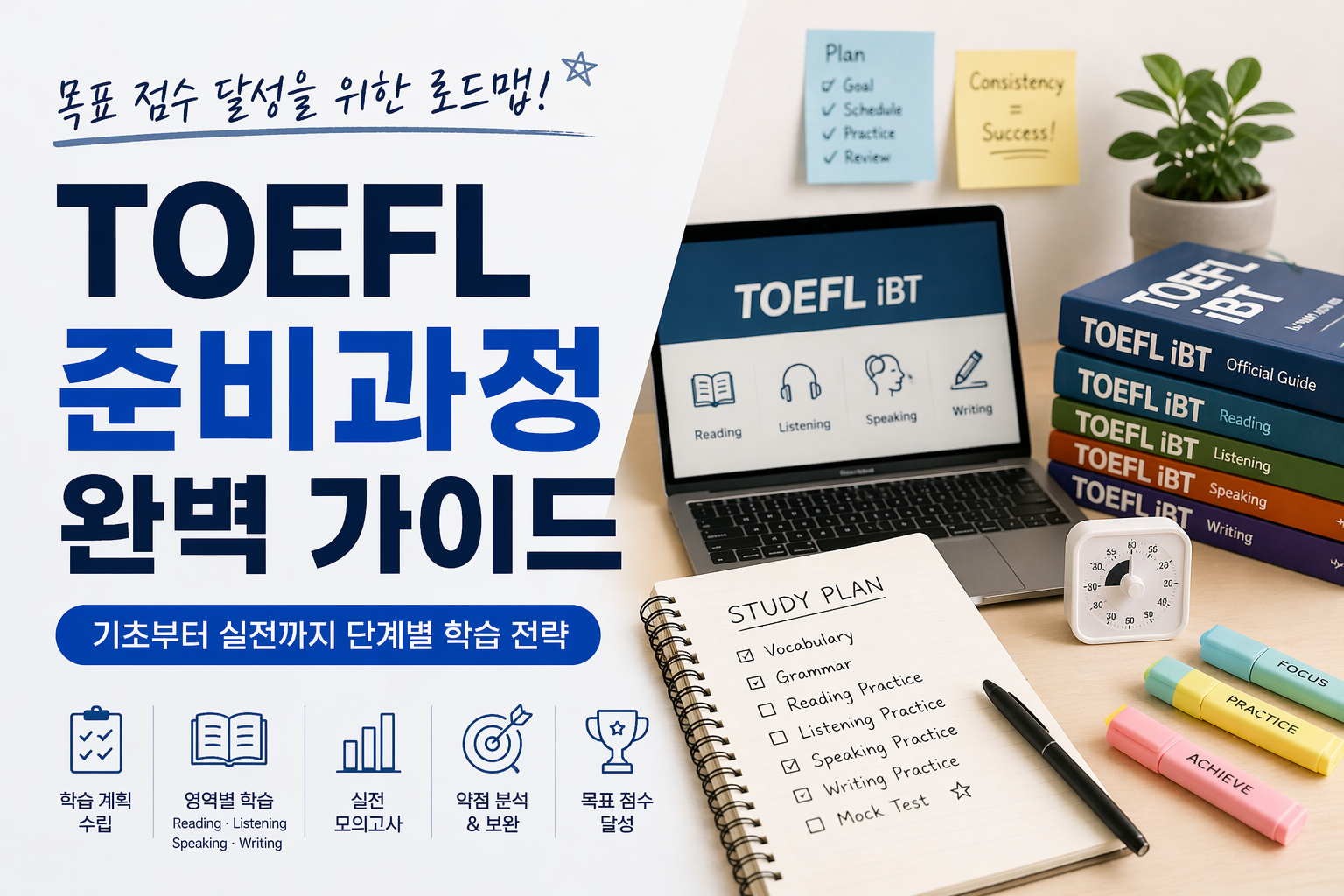
TOEFL is the first gate you pass through when applying to a US PhD program. What matters more than the score itself is deciding how much time to put into each section. I pushed Reading and Listening close to a perfect score through self-study, while I took a prep course for Speaking and Writing. Here’s why, and how.
Setting target scores
Most STEM PhD programs require a minimum score of 80–100. But hitting the minimum and getting a competitive score are two different things.
What matters more is your section-by-section score. Speaking in particular is tied directly to TA (Teaching Assistant) eligibility. Many schools, UTSW included, treat a Speaking score of 26 or above as the bar for TA eligibility. You can get admitted and still lose out on funding if you can’t TA.
Here’s what I set as my targets:
| Section | Target score | Max |
|---|---|---|
| Reading | 28–30 | 30 |
| Listening | 28–30 | 30 |
| Speaking | 24–26 | 30 |
| Writing | 24–26 | 30 |
| Total | 104–112 | 120 |
Reading — a perfect score is within reach through self-study
Reading is a section you can push up plenty far on your own, as long as you put in the time. The question types are fixed, and once you learn the patterns, your score ends up higher than your raw ability would suggest.
Knowing the question types is everything
TOEFL Reading questions break down roughly like this:
- Vocabulary questions — pick the word closest in meaning to a term in context
- Fact-checking questions — find information that’s stated directly in the passage
- Negative questions (NOT/EXCEPT) — pick the option that is not in the passage
- Inference questions — infer something based on the passage
- Sentence-insertion questions — find where a given sentence fits
- Summary questions — pick the three main points of the passage
Each type has its own solving strategy. For vocabulary questions you don’t need to read the whole passage, and for fact-checking questions you can just scan for the relevant paragraph using keywords.
How I prepared
- Start with the ETS Official Guide. It contains real past test questions, so it’s the best resource for learning the question types.
- Always analyze why you got a question wrong — was it a time problem, weak vocabulary, or a misunderstanding of the question type?
- Vocabulary sticks better when you pick it up in context within a passage rather than memorizing word lists separately.
For Reading, doing one passage a day, consistently, works better than cramming in short bursts.
Listening — also doable solo, but your ear has to open up first
Listening is also within reach through self-study, but it takes longer than Reading, because your ear has to open up first.
What’s distinctive about TOEFL Listening
- Two formats: lectures and conversations
- Lectures cover academic content (biology, astronomy, history, etc.)
- You only hear each clip once, but note-taking is allowed
Note-taking is the key
To get close to a perfect score on Listening, note-taking is essential. You’re not writing down everything — you need to quickly capture the key words and the logical structure.
It helps to develop your own shorthand. For example:
→: cause and effectvs: comparison/contrastex): example?: a spot where the professor asks a question
How I prepared
- Listen to English podcasts or TED talks every day. Content paced similarly to TOEFL Listening speed is ideal.
- Practice note-taking alongside real questions from the ETS Official Guide.
- For anything you get wrong, check the transcript to see exactly what you missed.
Speaking — take a prep course
Speaking has a clear ceiling when you study alone. It’s hard to objectively judge how your own pronunciation and delivery actually sound to someone else.
Why a prep course
- Immediate feedback: you find out right away what you’re doing wrong
- Template training: you learn how to structure an answer within the 15–30 second prep window
- Mock tests: you get to practice in conditions similar to the real exam
The structure of TOEFL Speaking
There are four tasks total:
- Task 1 — personal opinion (share your own view on a topic)
- Task 2 — read + listen + speak (a campus situation)
- Task 3 — read + listen + speak (an academic concept)
- Task 4 — listen + speak (summarize a lecture)
Except for Task 1, what matters is less your own opinion and more how accurately you convey what you heard. That’s why learning a structured template is such an advantage.
Writing — a prep course is far more efficient
Like Speaking, Writing is slow going if you’re just writing on your own and reading it back yourself. You need someone who knows the scoring criteria well and can point out the specific weaknesses in your writing.
The structure of TOEFL Writing
There are two types:
- Integrated Writing — read a passage + listen to a lecture → summarize the relationship between the two
- Academic Discussion — write your opinion in response to a professor’s question (10 minutes)
Academic Discussion replaced the old Independent Writing task starting in 2023. It’s short, but you need to demonstrate logical structure and vocabulary range quickly.
What a prep course teaches you
- Integrated Writing templates: a standardized structure for “reading claim → lecture rebuttal”
- Academic Discussion: training to complete an opinion + supporting reasons + example within 10 minutes
- Swapping in higher-scoring vocabulary and phrasing (plain expressions → more academic ones)
Test-date strategy
- TOEFL has a MyBest Scores system that lets you submit your highest score per section across multiple sittings (accepted by some schools).
- It’s safest to lock in your score 2–3 months before your application deadline. Score reporting can take up to two weeks.
- Don’t be afraid to retake it if you don’t hit your target. I took it twice myself.
Wrapping up
TOEFL is a test of English ability, but it’s also a test of strategy. Just by taking a different approach to each section, you can get a far more efficient outcome for the same amount of time invested. Building up Reading and Listening through pattern recognition on your own, while getting expert feedback for Speaking and Writing, was the most realistic approach for me.