Scholarship Strategy for a US PhD: Before You Apply vs. After You’re In
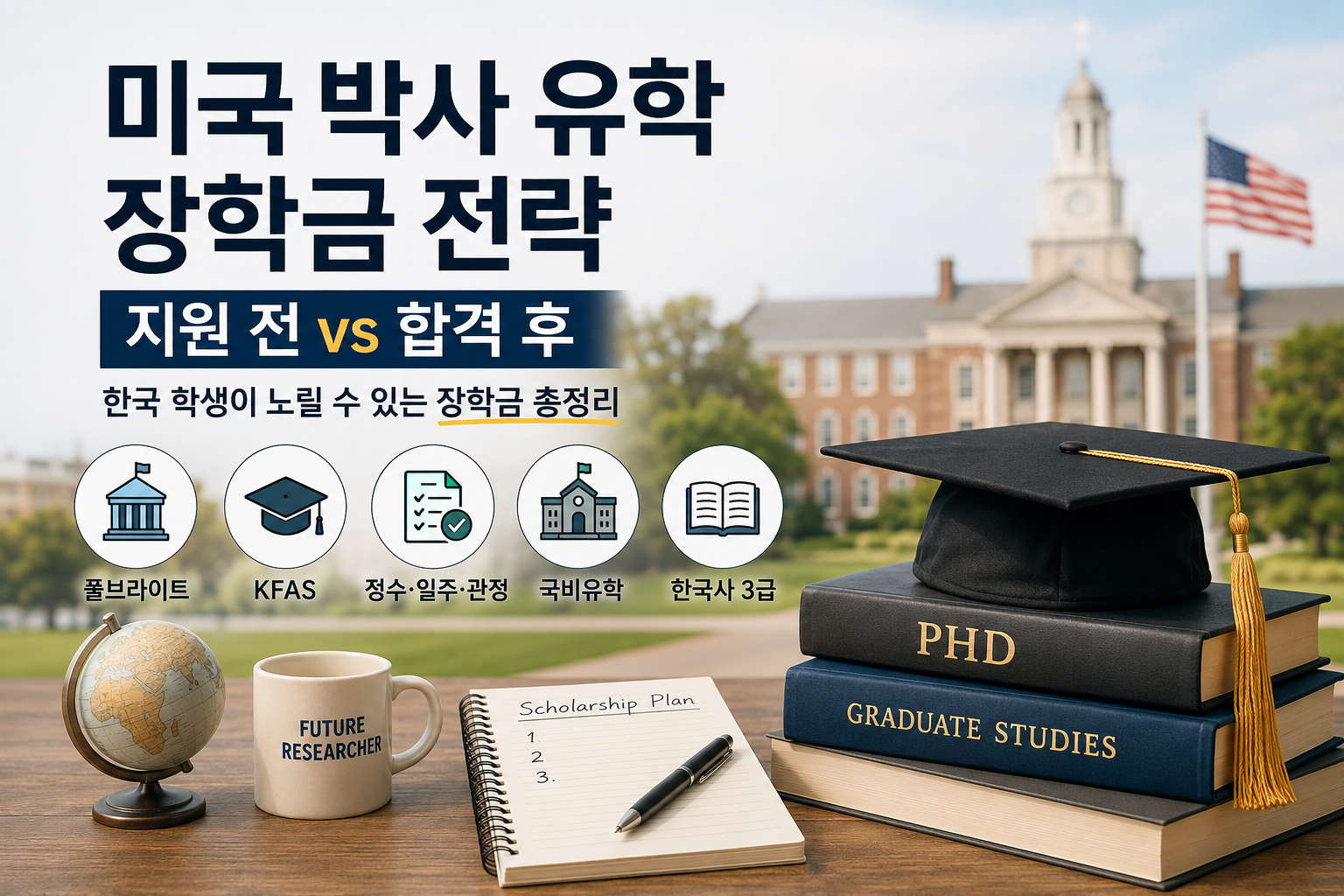
Scholarship Strategy for a US PhD: Before You Apply vs. After You’re In
If you spend any time preparing for a US PhD, you run into the money question faster than you’d expect.
Sure, most STEM PhD programs come with tuition waivers and a living stipend as standard. So there’s some truth to “you don’t pay to get a PhD.” But that doesn’t mean scholarships don’t matter.
An outside scholarship can strengthen your profile during admissions, and once you’re in, it buys you more room to focus on research. In some cases it also lowers how dependent you are on your advisor’s or department’s funding. And a scholarship is often a network in its own right.
For a Korean student preparing for a US PhD, the scholarships worth targeting fall into two broad timing buckets:
- Scholarships awarded before you apply to PhD programs
- Scholarships you apply for after you’ve been admitted
These two categories differ in how you prepare for them and in how much they actually affect your admissions outcome.
Pre-admission scholarships
Pre-admission scholarships, as the name suggests, are awarded before you’re admitted to a PhD program.
For these, the foundation evaluates your study plan, research direction, letters of recommendation, and often an interview — before you’ve been accepted anywhere. If you’re selected, you head into the US PhD admissions process as a “scholar-designate.”
The upside is obvious. Walking into admissions with financial support already secured is a real advantage. Schools and advisors also tend to find applicants who bring outside funding more attractive.
The two flagship scholarships in this category are Fulbright and KFAS.
Fulbright
Fulbright is a US government scholarship administered by the Korean-American Educational Commission. It’s one of the best-known scholarships among Korean students preparing to study in the US.
In terms of name recognition and prestige, it sits at the very top of the domestic options. It covers tuition, living expenses, and airfare, and the alumni network is strong.
That said, there are conditions you absolutely need to check before applying.
The return-to-Korea obligation
Fulbright comes with a return obligation: you’re required to live in Korea for a set period after your funding ends.
This isn’t just a “it’d be nice if you came back” suggestion — it’s closer to a legal obligation tied to your actual visa terms. So if you’re hoping to go straight into a postdoc in the US after your PhD, or to build a career there, you need to think carefully about this before applying.
Fulbright’s return obligation can directly affect your career plans. If you’re considering a postdoc or a job in the US after graduation, make sure this fits your plans before you apply.
The GRE requirement
As of 2026, Fulbright still requires GRE scores.
Plenty of US STEM PhD programs these days don’t accept GRE scores at all, or simply don’t consider them. So if you’re only thinking about a standard PhD application, you can often skip the GRE entirely.
But if Fulbright is on your radar, that changes. You may need to prepare for the GRE specifically for the scholarship application, even if none of your target programs ask for it.
KFAS (Korea Foundation for Advanced Studies)
KFAS — the Korea Foundation for Advanced Studies — is one of the strongest domestic scholarships in terms of both funding scale and network.
It’s been a major option for students heading abroad for a PhD for a long time. If you’re selected as a scholar-designate, you get the foundation’s support through the admissions process, and once you’re finally admitted, full funding covering tuition and living expenses.
KFAS’s biggest strength is its alumni network. Beyond the money, it plugs you into a long-term community of researchers.
But KFAS also comes with an important condition.
It depends on where you actually get in
Being selected as a KFAS scholar-designate doesn’t automatically lock in the scholarship.
The school you ultimately get admitted to has to meet the foundation’s standards — essentially, a “top school” bar. So even if you’ve been selected as a scholar-designate, your funding can be revoked or you can be dropped from consideration depending on where you end up enrolling.
Because of this, if you’re pursuing KFAS, you need to think about your scholarship strategy and your PhD application strategy together, not separately.
KFAS itself is generous, but where you ultimately get admitted matters just as much. Your outcome can still change after pre-selection, depending on which school you actually enroll in.
Post-admission scholarships
Next are the scholarships you can apply for after you’ve already been admitted to a PhD program.
These typically assume you already know which school you’re attending, and they give you additional financial support on top of that. Application windows for most of these tend to open early in the year.
Unlike pre-admission scholarships, these don’t have a direct effect on the admissions process itself. Instead, they help improve your financial footing once you’re already in.
Here’s a realistic list of what a STEM PhD student heading to the US might look at:
| Scholarship | Open to STEM applicants in 2026? |
|---|---|
| Jeongsu Scholarship | ✅ Yes |
| Iljoo Scholarship | ✅ Yes |
| Kwanjeong Lee Jong-hwan Educational Foundation | ✅ Yes |
| SBS Foundation | ❌ Restricted to humanities as of 2026 |
| Government-Sponsored Overseas Study (국비유학) | ✅ Yes, requires Level 3 on the Korean History exam |
As of 2026, the SBS Foundation scholarship is restricted to the humanities, so it’s effectively not an option for STEM students. For STEM students, the ones worth prioritizing are Jeongsu, Iljoo, Kwanjeong, and the government-sponsored overseas study program.
Jeongsu Scholarship (정수장학금)
The Jeongsu Scholarship is run by a foundation established by the SK Group.
It’s one of the scholarships open to students pursuing PhDs abroad, STEM students included. The number of recipients selected each year isn’t huge, so there’s real competition.
If you’ve already been admitted to a PhD program, it’s worth checking out. An additional outside scholarship gives you more breathing room financially, and it takes some pressure off when you want to spend time on things outside of research.
Iljoo Scholarship (일주장학금)
The Iljoo Scholarship is run by a foundation affiliated with the LS Group.
It’s known to be open to both STEM and humanities/social-science students, and it has a consistent track record of supporting students headed abroad for a PhD. Like the Jeongsu Scholarship, this is one you apply for after admission.
Application timing and specific requirements can shift a bit year to year, so it’s worth checking that year’s announcement directly.
Kwanjeong Lee Jong-hwan Educational Foundation (관정이종환교육재단)
The Kwanjeong Lee Jong-hwan Educational Foundation is on the larger end when it comes to funding amount among domestic foundations.
It’s especially well known as a scholarship for study abroad. If you’re preparing for a US PhD, this is one you should definitely check out.
What sets Kwanjeong apart is that its application timing is relatively flexible. It’s not structured so that you can only apply after formal admission — you can also apply as a scholar-designate.
In other words, you may be able to apply during the admissions process itself, even before you’ve received a final offer. That said, the actual scholarship is only confirmed once you’ve been formally admitted.
Kwanjeong’s application timing is relatively flexible. If you also hold scholar-designate status somewhere else, like KFAS, it’s worth thinking through your Kwanjeong strategy alongside it.
Government-Sponsored Overseas Study (국비유학)
The Government-Sponsored Overseas Study program is a scholarship funded by the Korean government for students studying abroad.
STEM fields are included among eligible areas. As a government scholarship, it’s institutionally stable, and it remains a meaningful option for students heading abroad for a PhD.
Unlike the other scholarships here, though, it comes with a requirement you need to prepare for separately.
Level 3 or higher on the Korean History exam
To apply for the Government-Sponsored Overseas Study program, you need Level 3 or higher on the Korean History Proficiency Test (한국사능력검정시험).
This requirement is surprisingly easy to miss. Between your SOP, CV, letters of recommendation, English test scores, and reaching out to advisors, there’s already a lot to juggle when preparing PhD applications.
If there’s even a chance you’ll go for this program, it’s worth taking the Korean History exam early. If you wait until the announcement comes out to start preparing, the timing can get awkward fast.
Putting the scholarship strategy together
It would sell US PhD scholarships short to think of them as just “a way to get more money.”
Pre-admission scholarships are tied to your admissions strategy. Being selected as a scholar-designate for something like Fulbright or KFAS can genuinely strengthen your applicant profile.
Post-admission scholarships, on the other hand, are tied to your stability after you enroll. Even if your department already funds you, having an outside scholarship on top of that widens your options.
Here’s the summary:
| Timing | Scholarship | Key thing to know |
|---|---|---|
| Pre-admission | Fulbright | 2-year return-to-Korea obligation, GRE required |
| Pre-admission | KFAS | Eligibility can hinge on where you ultimately get admitted |
| Post-admission | Jeongsu Scholarship | Open to STEM students going abroad for a PhD |
| Post-admission | Iljoo Scholarship | Worth checking for both STEM and humanities/social-science students |
| Post-admission | Kwanjeong Foundation | Large funding amount, open to scholar-designates too |
| Post-admission | Government-Sponsored Overseas Study | Requires Level 3+ on the Korean History exam |
Wrapping up
The financial side of preparing for a US PhD matters more than most people expect going in.
Just because your school offers funding doesn’t mean scholarships are irrelevant. If anything, outside scholarships matter across the board — research freedom, financial stability, how your career reads on paper, and network.
But the conditions vary a lot from scholarship to scholarship. Some come with a return-to-Korea obligation. Some depend on which school you get into. Some, like the Korean History exam, have separate eligibility requirements you need to plan for ahead of time.
So scholarships aren’t something to “figure out once I get in” — they’re worth thinking through alongside your overall PhD application strategy from the start.
Pre-admission scholarships in particular are tied to the admissions timeline, so you need to prepare for them early. Post-admission scholarships, by contrast, are more about knowing when the announcements come out and what documents you’ll need, so you can move fast once you get your offer.
In the end, it comes down to one thing.
When you’re preparing for a PhD abroad, scholarships aren’t a nice-to-have add-on — they’re part of the strategy itself.