How to Write a US PhD Application CV — Bottom-Up and Top-Down
The first time you sit down to write a CV, it’s strangely paralyzing.
You open a blank document and the questions start piling up.
“What kind of person am I?”
“What should I emphasize?”
“Is this experience even worth including?”
I used to think of a CV as a kind of “compressed personal statement.” So I tried to define myself convincingly right from the start. The problem is that doesn’t really work. You haven’t even laid out your raw material yet, and you’re already trying to write the conclusion — of course you get stuck.
So the draft usually ends up looking like this.
Lab name, dates, a one-line description.
A handful of conference talks.
A few scholarships.
A list of technical skills.
None of it is wrong, exactly, but it doesn’t stick with the reader. From the admissions committee’s side, it’s hard to tell what kind of researcher this person actually is.
Here’s the approach I think works better.
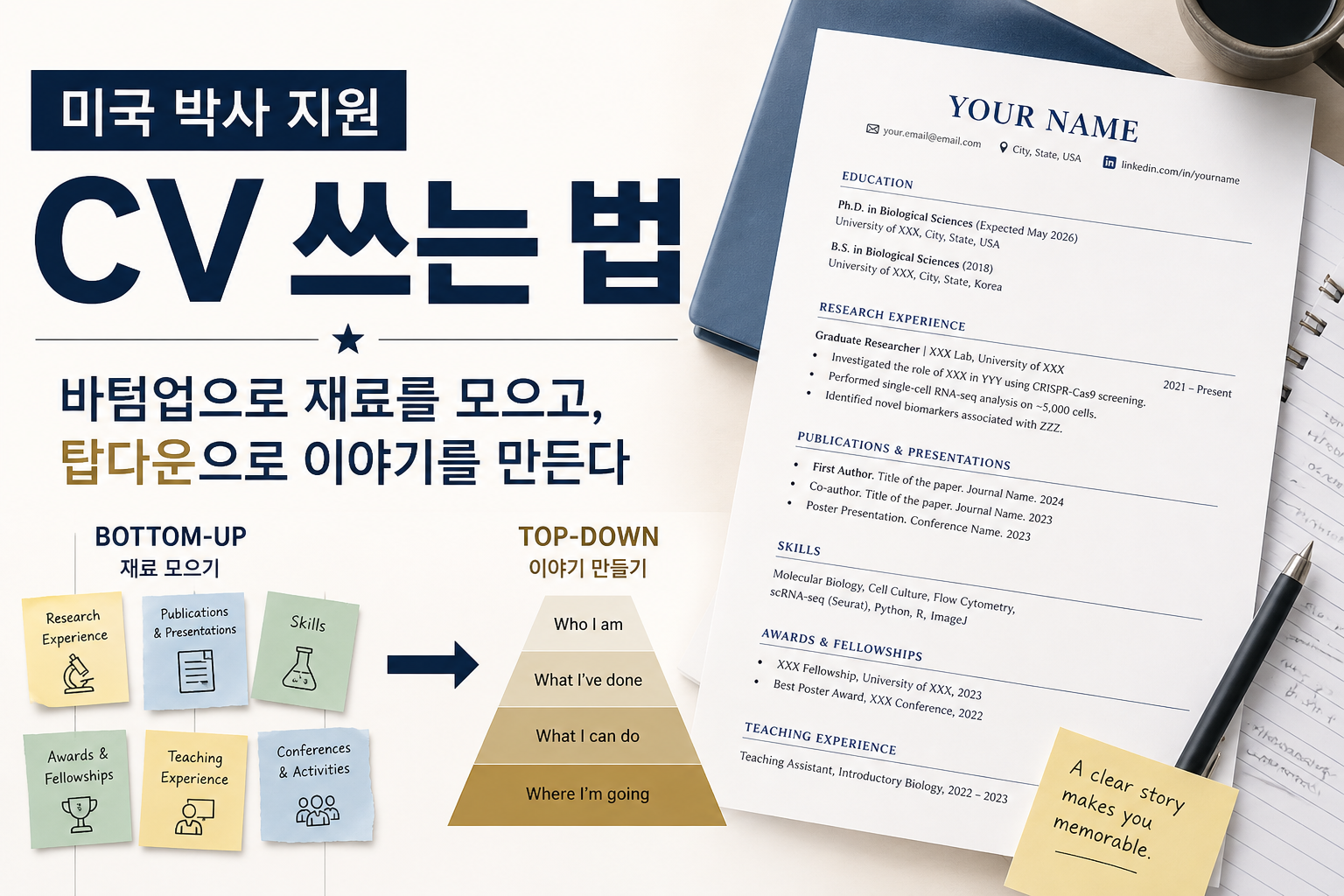
First, go bottom-up: gather as much raw material as you possibly can.
Then go top-down: organize that material into a single story.
A CV isn’t just a list of accomplishments. It’s a document that shows what you’ve experienced, what kind of researcher you’ve grown into, and where you want to go from here.
Step 1. Bottom-up — get everything out on the table
Don’t start by asking “is this good enough to put on my CV?” That question can wait.
The first thing to do is just dump everything out, even if some of it looks minor. It’s fine if there was no clean result. It’s fine if it never turned into a paper.
Write down everything you’ve done, as specifically as you can.
Research experience
Write down everything you did in every lab you’ve been part of.
Include short stints too — undergrad internships, master’s research, exchange research, a summer project. What matters isn’t “where you were” but “what you actually did.”
For example:
- What experimental technique did you personally perform
- What samples or models did you work with
- Did you lead the project, or assist on it
- Did the results turn into a paper, a poster, or a talk
- Even if it failed, what problem did you solve along the way
Only some of this will end up in your final CV, but at this stage, write down as much as you can.
Publications and presentations
Korean students tend to undersell their conference presentations more than you’d expect. Domestic conference posters, in particular, often get left off with a “should I even count this?” — I think you should include them.
- Papers where you’re an author
- Co-authored papers
- Posters at domestic or international conferences
- Oral presentations
- Preprints
- Manuscripts under submission or in preparation
A finished paper isn’t the only kind of research output. A poster presentation or a conference experience is evidence that you were active in a research community.
Awards and fellowships
Write down every scholarship or award you’ve received, for now.
- Merit-based tuition scholarships
- Research fellowships
- Experience related to national research funding
- Poster prizes, paper awards
- Academic excellence awards
You can always narrow this down later, so there’s no need to filter too strictly from the start.
Teaching and mentoring
A PhD isn’t just research. You’ll TA, mentor a junior student, or teach someone within your lab.
So these experiences matter more than you’d think.
- TA experience
- Mentoring a junior lab member’s experiments
- Tutoring
- Private tutoring
- Running a seminar
- Leading a reading group
Especially in programs that don’t require a separate Teaching Statement, a short line on your CV can do the job of showing this competency.
Other experience
This category catches the things that are easy to leave out because they feel ambiguous.
Military service, for instance. For Korean men, this creates a gap of nearly two years, and it’s better to note it briefly than to leave an unexplained blank.
The same goes for language ability. If you have a TOEFL score or other language credentials, you can list them separately.
The goal at this stage isn’t to write a good CV.
It’s to gather as much raw material as possible so you can write a good CV.
Step 2. Top-down — what kind of researcher do I want to be remembered as
Once you’ve laid out all your material, the next step is to come at it from the opposite direction — from the top down.
There’s one question that matters here.
After reading my CV, how do I want the admissions committee to remember me?
Without this question, a CV is just a chronological résumé. With it, a CV starts to read like an argument.
You don’t have to say “this is who I am” directly — the arrangement of your experiences and the words you choose will carry that message on their own.
Possible narratives
Different applicants can tell different stories.
Some people have gone deep in one field for a long time.
Five years in an immunology lab, from undergrad through a master’s.
Digging progressively deeper into the same question, which led to papers and poster presentations.
For this kind of applicant, a depth narrative works well.
Some people have switched fields.
Started in pharmacy school, but grew increasingly drawn to basic immunology research, wanting to translate clinical questions into the language of basic science.
This becomes a transition narrative.
And some people connect two fields.
Working in immunology while also handling genomic analysis, looking at T cell development through scRNA-seq data.
This is closer to a fusion narrative.
I was closer to the transition type. I came from a pharmacy background, but did basic immunology research in my master’s. So on my CV, I wanted to show a clear arc: “I have a pharmacy background, but I’m now training as a basic immunologist, and these two backgrounds together will benefit my future research.”
Once I’d settled on that, it became much clearer what to emphasize.
Step 3. Choosing and arranging your material
Once you’ve settled on a narrative, go back to the material you gathered bottom-up.
The criterion is simple.
Does this experience support the researcher I want to present myself as?
If it helps, keep it. If it’s not particularly relevant, trim it or cut it.
For example, if I want to come across as a basic immunologist, but the front of my CV is cluttered with old one-off activities or awards unrelated to research, that can actually blur the focus.
Conversely, even a domestic conference poster is worth including if it connects directly to your research topic. It might sound less impressive by name, but it still helps show the throughline of your research.
What to keep
I generally think it’s worth prioritizing the following.
| Keep | Trim or cut |
|---|---|
| Research experience directly connected to the field you’re applying to | One-off activities unrelated to your narrative |
| Experiments or analyses you actually performed yourself | Experience at the level of mere participation |
| Projects with concrete results | Experience too old to reflect your current abilities |
| Experience where your own initiative is visible | Items that don’t translate into a strength, however you explain them |
Cutting something doesn’t mean throwing it away. It stays in your master inventory document. You’re just not including it in this particular application’s CV.
A CV isn’t a document that shows everything.
It’s a document that selects what best represents you for this specific application, right now.
Step 4. Setting the section order
For a US PhD application, the following order generally works well.
Education Research Experience Publications & Presentations Awards & Fellowships Skills Teaching / Mentoring
In most cases, the most important section is Research Experience. That’s where you should devote the most space.
If your publication record is strong, put Publications right after Research Experience. If you don’t have publications yet but your research experience is solid, describe your projects in more detail within Research Experience instead.
What matters here isn’t a “correct” order — it’s the order that surfaces your strengths the fastest.
Don’t assume the admissions committee will read your CV carefully from start to finish. Within the first few seconds, they need to get a sense of what kind of applicant you are.
Step 5. Research Experience is the heart of the CV
The section that makes the biggest difference in a CV is Research Experience.
A lot of drafts look like this.
Studied T cell biology in immunology lab.
It’s not a wrong sentence. But it conveys almost no information.
You can’t tell which T cells were studied, what system was used, what experiments or analyses were performed, or whether there were any results.
A good bullet usually contains three things.
- What you did
- At what scale or under what conditions
- What you found as a result
For example, you could write it like this.
Performed scRNA-seq analysis on CD4+ T cells from 10 SLE patient samples using Seurat v4, identifying a disease-associated Th17 subpopulation not previously described in Korean cohorts.
Reading this sentence, you can see far more information.
- Can work with scRNA-seq
- Has experience analyzing data using Seurat
- Worked with SLE patient samples
- You can tell roughly how many samples were involved
- Didn’t just run an analysis — identified a specific subpopulation
At this level of detail, the reader can start to picture what this applicant can actually do.
The verb matters more than you’d think
The first word of a CV bullet carries real weight, because it determines the role the person is perceived to have played.
Phrases like Participated in, Assisted with, or Helped with come across as too passive. Even if what you actually did was substantial, the sentence can make it look small.
That said, don’t overstate things either. Don’t write Led if you didn’t actually lead the project. But if you designed, executed, and analyzed something yourself, use a verb that reflects that.
| Weak phrasing | Better phrasing |
|---|---|
| Participated in | Designed / Executed / Led |
| Assisted with | Developed / Optimized / Characterized |
| Helped to | Identified / Demonstrated / Established |
| Was involved in | Analyzed / Generated / Validated |
The point isn’t to use impressive-sounding words. It’s to describe what you did at the right intensity.
Overstating on a CV is risky, but underselling yourself costs you too.
Step 6. What Korean applicants often leave out
The first time you write a US-style CV, you tend to default to Korean résumé conventions. So you end up leaving out things you should include, or including things you don’t need to.
Domestic conference presentations
Posters from Korean societies — the Korean Association of Immunologists, the Korean Society for Molecular and Cellular Biology, and the like — are fine to include. Especially if they connect to your research topic, they carry real weight.
International conferences aren’t the only ones that count. What matters is that you actually organized your research findings and presented them.
Military service
Military service can be noted briefly.
Republic of Korea Army, Sergeant, 2020–2022
That’s enough. You don’t need a detailed explanation. But it’s still better than leaving an unexplained gap.
GPA conversion
It’s safer not to convert your Korean GPA into the US scale yourself.
GPA: 4.25/4.5
Write it in its original scale, as is. Some schools convert it themselves, or require a credential evaluation service like WES if needed. A GPA you’ve converted yourself can end up creating more confusion than clarity.
Language ability
If you have a TOEFL score, you can note it briefly under Skills or in a separate section.
English: Professional working proficiency; TOEFL iBT 112
That said, if your English score already goes into the application portal separately, you don’t necessarily need to spell it out at length on your CV. If space is tight, adjust based on priority.
Final checklist
Once you’ve finished your CV, it’s worth checking the following.
A US PhD application CV doesn’t need to be one page. If you have enough research experience, two or three pages is fine. What matters isn’t length, but density.
Closing thoughts
A CV isn’t something you write once and leave alone. It keeps changing depending on the schools you’re applying to, the PIs you’re interested in, and your most recent research results.
So trying to make the “perfect” CV from the start is actually the harder path. It’s much better to first gather enough material bottom-up, and then organize it top-down to fit the purpose of each application.
I also used to think of a CV as “a list of what I’ve done.” But my thinking shifted a bit while preparing my applications.
A CV isn’t just a list — it’s a compressed story of what kind of researcher you’ve been trained to become.
The more material you have, the more choices you have. And the clearer your direction, the more persuasive that material reads.