Getting Ready to Buy My First Car in the US: New vs. Used, the Essentials
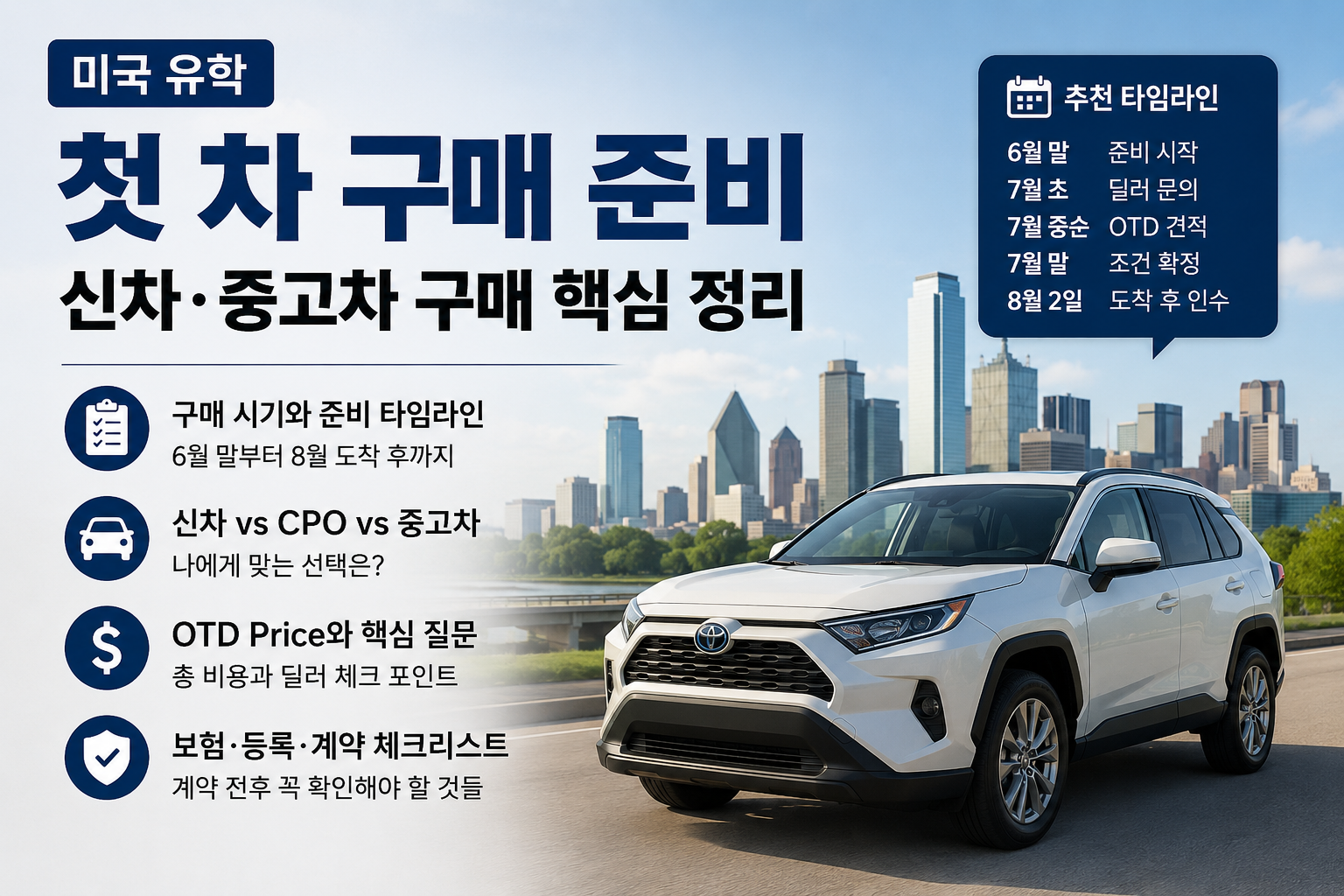
Getting Ready to Buy My First Car in the US: New vs. Used, the Essentials
A car is a pretty big expense when you’re studying in the US.
In a place like Dallas, where having a car makes life dramatically easier, it’s worth thinking ahead about how you’re going to buy one before you even land.
I’m scheduled to arrive in the US on August 2, so I put together a plan for how to prepare for buying a car between now and then.
The short version
If you’re arriving August 2, you don’t need to start blasting dealerships with emails at the end of June.
Right now is the time to nail down the vehicle type, budget, trim, and a list of dealers — not to negotiate a final price.
Here’s the timeline I’d recommend.
- Late June: Decide on vehicle type, budget, and must-have options
- Early July: Track inventory trends at dealers around Dallas
- Mid-July: Request out-the-door (OTD) quotes for actual vehicles with a VIN
- Late July: If a good deal comes up, lock it in with a refundable deposit
- After arriving August 2: Get insurance, visit the dealer, sign, take delivery
If you want a popular model or a specific hybrid, it’s fine to start light inquiries now, but the real quote-shopping should probably wait until mid-July or later.
1. Rental car vs. Uber right after arrival
Booking a long 2–3 week rental car right from the start can be a bit of a waste of money.
If you’re planning to buy a car quickly, it’s more realistic to get by on Uber, DART (Dallas’s public transit), and the school shuttle for the first few days after landing.
My recommended approach
First 3–5 days after arrival
- Uber
- DART
- School shuttle
- Grocery runs only when needed
Days you’re out car shopping
- Rent for just 1–3 days if needed
If delivery of your car is delayed 1–2 weeks
- Consider a roughly 1-week rental then
In other words, rather than booking a long-term rental upfront, it’s better to rent only as much as you need once you have a clearer sense of your delivery timeline.
2. If you have the cash for a new car
If you have cash on hand for a new car, your options get a lot simpler.
Even without an SSN or a US credit history, buying with cash may still let you purchase a new car.
That said, policies vary by dealer, so it’s worth confirming in advance.
Here’s how to ask a dealer:
I am an international student on F-1 visa.
I do not have an SSN yet.
I plan to purchase without financing.
Can you complete the sale, title, and registration with my passport, I-20, I-94, proof of insurance, and U.S. address?
On the other hand, if you want to finance or lease, an SSN, US credit history, and proof of income become important.
Students who just arrived in the US often struggle to get good financing terms, so if you can pay cash for a new car, that route can be cleaner.
3. Will it take a long time to get the car?
How fast you can get a car depends heavily on the model.
If the dealer already has the vehicle on the lot, you might be able to take delivery within days as long as insurance is sorted. But certain colors, certain trims, and popular hybrid models can mean waiting several weeks or more.
So what matters isn’t just hearing “we have it in stock” — it’s confirming the following:
The key is always talking in terms of a specific vehicle with a VIN.
4. Used, CPO, or new — which is better?
Early on, you might consider a used car or a CPO (Certified Pre-Owned) vehicle too.
But when used car prices are high, the price gap between a well-maintained CPO and a new car can end up smaller than you’d expect. In that case, just buying new can be a perfectly good option.
When new makes sense
- You plan to keep the car a long time
- You want to minimize the stress of breakdowns
- You don’t want to worry about vehicle history
- You can pay cash
- The price gap with a used car isn’t large
When CPO makes sense
CPO stands for Certified Pre-Owned.
It’s a manufacturer-certified used car — pricier than an ordinary used car, but it usually comes with an inspection and additional warranty.
For a student who doesn’t know cars well, this can be safer than buying from a private seller.
When a regular used car makes sense
- You want to lower your upfront cost
- Depreciation is a real concern for you
- You have time to find a good deal
- You know how to assess a car’s condition, or can get an inspection done
That said, for a student who just arrived in the US, official dealers, CPO programs, and large platforms like CarMax or Carvana are likely safer than a private-party sale.
5. What about Korean-American dealers?
This isn’t to say you should avoid Korean-American (“hanin”) dealers altogether.
Being able to communicate in Korean is a genuine advantage.
But trusting a dealer’s price and terms without verifying them, just because they speak Korean, is risky.
Whether the dealer is Korean or not, the standards that matter are the same:
In the end, what matters is whether the dealer gives you transparent pricing and paperwork.
6. Decide on vehicle type and conditions first
Before you contact a dealer, you need to define what you’re looking for first.
On US dealer sites, even the same model can vary quite a bit in price depending on trim, options, packages, and color.
If your approach is just “I want to buy some kind of SUV,” it’s easy to get steered toward whatever the dealer wants to show you.
Decide these first
7. Choosing a brand and trim
When buying your first car in the US, practicality matters more than emotional appeal.
If it’s a car you’ll drive for your whole PhD, you also need to weigh:
- Maintenance cost
- Insurance cost
- Fuel economy
- Resale value
- Access to service/repair shops
- Parts availability
- Comfort on long drives
- Interior space
- Safety features
Commonly considered brands include Toyota, Honda, Mazda, Subaru, Hyundai, and Kia.
Options to check when comparing trims
- Blind Spot Monitoring
- Rear Cross-Traffic Alert
- Rear A/C Vents
- Apple CarPlay / Android Auto
- Adaptive Cruise Control
- Lane Keeping Assist
- Backup Camera
- Power Liftgate
- Alloy Wheels
- Whether it has AWD (all-wheel drive)
Dallas doesn’t get much snow, so AWD isn’t a must-have.
But if you travel often or prefer an SUV, it’s still worth considering.
8. The most important number: the OTD Price
When buying a car in the US, the OTD Price matters more than the MSRP.
MSRP
MSRP stands for Manufacturer’s Suggested Retail Price.
In plain terms, it’s the manufacturer’s recommended price — essentially the sticker price on the car.
But the amount you actually end up paying is different from the MSRP.
OTD Price
OTD stands for Out-the-Door Price.
It’s the final amount you actually have to pay.
The OTD price typically includes:
- Vehicle price
- Taxes
- Title fee
- Registration fee
- Dealer documentation fee
- Mandatory add-ons
- Other miscellaneous fees
You should always ask the dealer this:
Can you send me the full out-the-door price in writing?
A written quote matters far more than a verbal one.
9. Key questions to ask the dealer
When you reach out to a dealer, these are the only questions you really need to nail down:
If a dealer won’t give you a quote, keeps pushing you to just come in, or is evasive about the OTD price, there’s no need to keep pursuing them.
10. A simple email to send to dealers
In early July, a light inquiry like this works well.
Hello,
I will be arriving in Dallas on August 2 and plan to purchase a vehicle shortly after arrival.
I am interested in the [MODEL / TRIM].Could you let me know if you expect any in-stock or in-transit vehicles available around late July or early August?
I am an international student on F-1 visa and may not have an SSN yet. I plan to purchase without financing.
Can your dealership complete the sale, title, and registration with my passport, I-20, I-94, proof of insurance, and U.S. address?Thank you.
From mid-July onward, once there’s an actual vehicle with a VIN, you can follow up with:
Could you please send me the full out-the-door price in writing, including all taxes, registration/title fees, dealer fees, and any mandatory add-ons?
11. Get quotes from multiple dealers under the same conditions
The single most important strategy in buying a car is getting quotes from several dealers under identical conditions.
If you only talk to one dealer, you have no way of knowing whether you’re getting a good price.
My recommended approach
- Same model
- Same trim
- Similar color
- Similar options
- An actual vehicle with a VIN
- The same OTD basis
Request quotes from multiple dealers on these matched terms.
Once you have the best quote, you can go back to other dealers and ask:
I received a lower out-the-door quote from another dealership.
If you can match or beat it, I would be willing to move forward.
That said, there’s no need to be overly aggressive about it.
What matters is staying polite, keeping everything in writing, and getting clear numbers.
12. What to watch for when signing
On the day you sign, make sure to double-check that none of the numbers have changed.
Things to check
The finance office may try to upsell you on a warranty or protection package.
If you don’t want it, you can just say:
I would like to decline all optional add-ons.
13. Payment and insurance
Even if you’re paying cash, I wouldn’t recommend actually walking in with physical bills.
These options are usually safer:
- Open a US bank account
- Cashier’s check
- Wire transfer
- Check whether partial payment by card is allowed
And you’ll need insurance before you can drive the car off the lot.
So it’s worth getting insurance quotes before you finalize the car deal.
Students without a US driving record can end up with higher insurance premiums.
You need to budget for insurance on top of the price of the car itself.
14. My recommended timeline
Now through late June
Early July
Mid-July
Late July
After arriving August 2
The takeaway
If you’re arriving August 2, there’s no need to blast dealerships with mass emails right now.
Right now is the time to nail down vehicle type, budget, trim, and a dealer list, and the real OTD quote-shopping should start mid-July or later.
Right after arrival, it’s more realistic to get by on Uber/DART for a few days and rent short-term only on the days you’re out car shopping, rather than booking a long-term rental.
If you can pay cash for a new car, you may not strictly need an SSN — but confirm that with the dealer ahead of time.
These three things matter most:
- Always evaluate a specific vehicle with a VIN
- Get the OTD price in writing
- Watch out for unnecessary add-ons and warranties
In the end, the key to buying your first car isn’t landing the best possible deal — it’s not rushing into a bad one.